English ![]()

Tel:
+86-13802806440
E-mail:
+86-13480210489
+86-20-31104009
+86-20-31104009
E-mail:

Views: 0 Author: Site Editor Publish Time: 2026-08-04 Origin: Site
Selecting jewelry is frequently treated as a purely aesthetic choice, but long-term satisfaction relies heavily on material science, structural ergonomics, and geometric compatibility. Buyers often face a disconnect between visual appeal and practical wearability. This leads to investments in pieces that cause contact dermatitis, stretch the earlobe, or fail to integrate with daily wardrobe demands and styling variables. Finding the right balance requires more than just picking a pretty design from a display case.
This guide provides a systematic, evidence-based framework for evaluating earrings for women. We focus on metallurgical composition, structural security, and stylistic longevity to ensure informed purchasing decisions. You will learn how to assess metal quality, match geometric shapes to facial structures, and evaluate fastening mechanisms for daily security. By applying these principles, you can build a jewelry collection that offers both comfort and enduring style.
Material Compliance is Non-Negotiable: Prioritize verified metallurgical standards (like 925 hallmarks) to mitigate the risk of nickel allergies and ensure long-term durability.
Ergonomics Dictate Wearability: Earring weight and backing mechanics directly impact lobe health; daily wear pieces should fall below specific gram thresholds to prevent tissue stretching.
Geometry and Hair Framing Influence Aesthetics: Strategic selection of earring shapes (studs, hoops, dangles) can visually balance facial structures and coordinate with specific hairstyles.
Occasion and Recipient Profiles Matter: Successful styling—and gifting—requires alignment with dress codes, hair lengths, and the personal aesthetic profile of the wearer.
Earring weight directly impacts the long-term health of your earlobes. For daily wear, individual earrings should generally weigh under 7 grams. This threshold prevents constant downward pulling on the piercing tract. Occasional wear pieces, such as heavy chandeliers, can weigh more but should be worn for limited hours. Exceeding these limits regularly leads to tissue laxity and elongated piercings. When you wear heavy pieces day after day, the skin loses its elasticity, which can eventually require surgical correction.
Weight distribution also matters significantly. Compact studs concentrate their mass directly against the lobe, offering better support. Elongated designs act as levers, multiplying the downward force as you move. Understanding this mechanical difference helps you select comfortable pieces for extended wear. If you prefer larger designs, look for hollow construction techniques that provide volume without the associated mass.
Earring Style | Recommended Max Weight (per ear) | Wear Frequency | Primary Risk if Exceeded |
|---|---|---|---|
Daily Studs | 2 - 4 grams | Everyday / Continuous | Minimal risk |
Medium Hoops | 5 - 7 grams | Frequent / Office wear | Slight piercing elongation over decades |
Statement Dangles | 8 - 12 grams | Occasional / Events | Temporary soreness, tissue stretching |
Heavy Chandeliers | 13+ grams | Rare / Short duration | Immediate discomfort, severe lobe laxity |
A smart jewelry purchase transitions seamlessly between different environments. You want designs that work in professional settings, casual weekends, and formal events. Minimalist geometric shapes often provide the highest versatility. Evaluating how a piece integrates with your existing wardrobe ensures it won't sit unworn in a jewelry box. Think about your standard weekly outfits and visualize whether a new pair of earrings complements at least three distinct looks.
The concept of Cost Per Wear is highly applicable to fine and demi-fine jewelry. Divide the purchase price by the estimated number of times you will wear the item. High-quality basics yield a remarkably low cost per wear over time. Trend-heavy statement pieces typically result in a higher cost per wear, dictating a different budget allocation. Investing in durable, classic designs ensures you get maximum utility from your collection.
Different environments demand specific styling choices. Professional boardrooms usually require understated designs like small studs or huggies that do not distract. Casual wear allows for playful textures and mixed metals. Cocktail events and formal black-tie occasions are the proper venues for dramatic drops and high-sparkle gemstones. Knowing the unwritten rules of these environments helps you project the right image.
Understated silver earrings serve as excellent grounding elements for bold, colorful outfits. Conversely, bold statement designs can elevate a simple, monochromatic dress. Balancing the visual weight of your jewelry with your clothing ensures a cohesive look.
Assess the formality of the event before selecting your jewelry.
Match the metal tone to any hardware on your clothing or accessories.
Ensure the earring length does not interfere with high collars or scarves.
Select secure backings if the occasion involves physical activity or dancing.
Buying jewelry as a gift requires careful observation of the recipient's personal style. Categorize their aesthetic into profiles like minimalist, classic elegant, bohemian, or dramatic. A minimalist prefers clean lines and subtle metals. A bohemian style aligns well with organic textures and natural stones. Pay attention to the pieces they wear daily to gauge their comfort zone.
You must also match the metal durability and closure type to their daily environment. Active individuals need secure closures like screw backs or leverbacks. Office workers might prioritize comfort for long hours at a desk. Tailoring the mechanics to their lifestyle guarantees the gift is actually wearable and appreciated.
The 925 standard dictates that the metal consists of 92.5% pure silver and 7.5% alloy. This specific ratio is the baseline for quality 925 Sterling Silver Earrings. Pure silver is too soft for functional jewelry making. It bends and scratches easily under normal wear. By alloying it, jewelers create a material that can withstand daily use while maintaining the bright, reflective qualities of pure silver.
Copper or zinc is typically used as the 7.5% alloy. These metals provide necessary structural integrity without compromising skin safety. This combination ensures the jewelry holds its shape, secures gemstones tightly, and resists daily deformation. When evaluating a piece, the presence of this specific alloy ratio is what separates fine jewelry from disposable fashion accessories.
Evaluating metals requires understanding structural and financial trade-offs. 925 sterling silver offers excellent durability at an accessible price point. Vermeil provides a thick gold layer over a silver base, offering a gold aesthetic with a silver core. Solid gold presents higher upfront costs but superior resistance to tarnishing. You must weigh your budget against your willingness to perform routine maintenance.
Silver possesses the highest thermal and electrical conductivity of all metals. This means pure Sterling Silver Earrings quickly adapt to your body temperature. This rapid thermal adjustment makes them exceptionally comfortable to put on, even in cold environments. Unlike cheaper base metals that can feel cold and rigid, silver warms up instantly against the skin.
Metal Type | Composition | Durability | Hypoallergenic Profile |
|---|---|---|---|
925 Sterling Silver | 92.5% Silver, 7.5% Copper/Zinc | High (Prone to tarnish) | Excellent (if nickel-free) |
14k Solid Gold | 58.3% Gold, 41.7% Alloy | Very High | Excellent |
Gold Vermeil | Gold plated over 925 Silver | Moderate (Plating wears) | Very Good |
Silver-Plated Brass | Thin silver layer over brass | Low | Poor (High allergy risk) |
Verifying authenticity requires reading industry hallmarks and stamps. Look for "925", "STER", or "Sterling" stamped on the post or the inside of a hoop. These marks legally indicate the piece meets solid sterling standards. Absence of these stamps often suggests a plated base metal. Always inspect the hidden areas of the jewelry, such as the back of a pendant or the curve of an ear wire, for these tiny engravings.
The degradation lifecycle of silver-plated brass is rapid. The thin silver layer rubs off with friction, exposing the brass underneath. This leads to green skin discoloration and structural weakness. Solid silver maintains its integrity throughout its lifespan, requiring only surface polishing. Investing in solid metals prevents the disappointment of a favorite piece degrading after just a few months of wear.
Low-tier jewelry frequently contains common allergens, primarily nickel and lead. Nickel is often used to add shine and durability to cheap alloys. However, it is the leading cause of contact dermatitis in jewelry wearers. Avoiding these metals is critical for long-term comfort. Once a nickel allergy develops, it is usually a lifelong condition, making preventative metal selection highly important.
Rhodium plating over silver acts as a highly functional barrier for hyper-sensitive skin. Rhodium is a member of the platinum family. It provides a bright white finish, prevents tarnishing, and completely blocks the base metal from touching the skin. If you have extremely reactive piercings, seeking out rhodium-plated options provides an extra layer of security.
Studs are the foundation of any jewelry collection. They are best suited for oval and long facial structures requiring horizontal balance. By sitting directly on the lobe, they draw the eye outward rather than downward. This creates a visually pleasing proportion for elongated faces. A well-chosen stud can serve as a daily uniform piece that requires zero styling effort.
The gemstone setting dictates light refraction. Prong settings allow maximum light to enter the stone from all angles, increasing brilliance. Bezel settings encircle the stone in metal, offering superior security and a sleek, modern profile, though slightly reducing sparkle. Consider your daily activities; if you work with your hands or frequently change clothes, a bezel setting prevents the earring from snagging on fabrics.
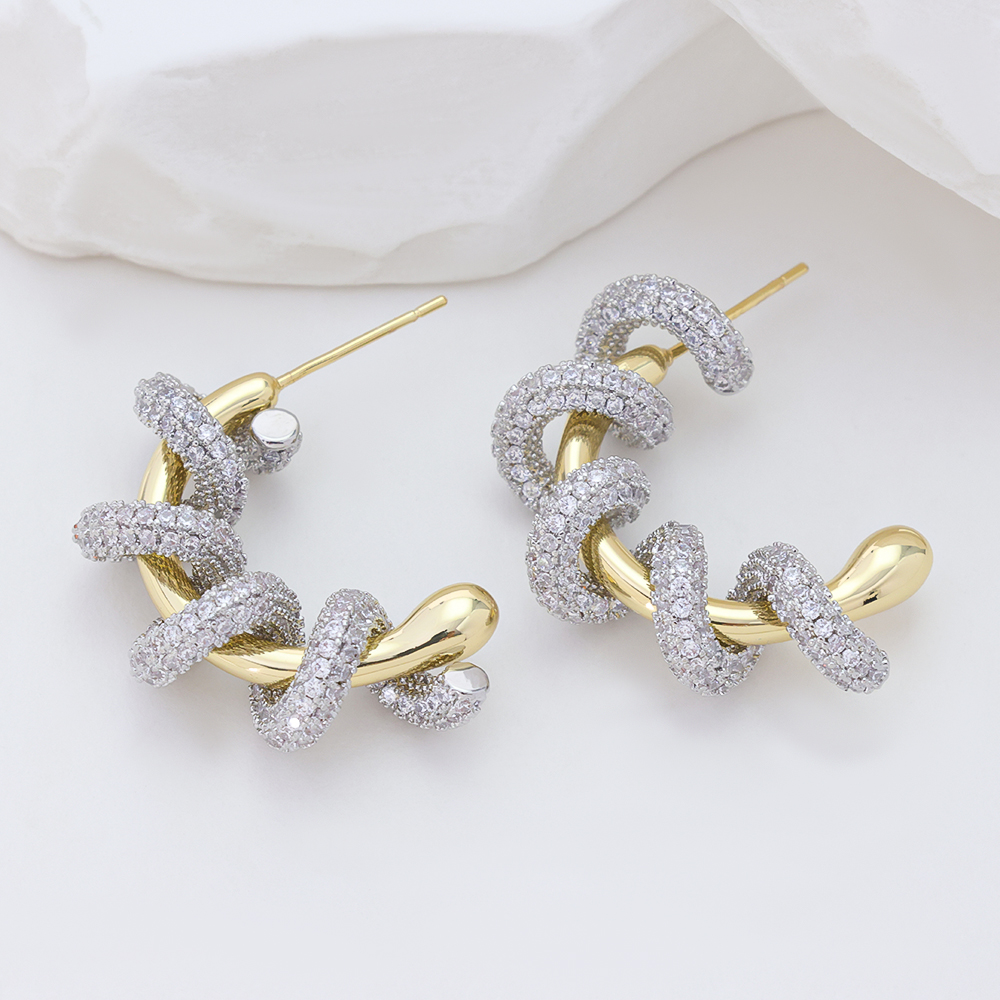
Hoops introduce circular geometry to the face. They are ideal for angular, square, or diamond-shaped faces. These face shapes are characterized by a pointed chin, defined cheekbones, and a V-shaped hairline. The curves of the hoops soften sharp facial angles effectively. The continuous loop design draws attention to the jawline and neck, creating a balanced visual profile.
Assess the structural differences before purchasing 925 Sterling Silver Hoops Earrings for Women. Hollow tubing creates a lightweight piece suitable for large diameters. Solid wire hoops offer superior durability against bending but become heavy quickly as the size increases. If you opt for large diameters, hollow construction is mandatory to protect your earlobes from stretching.
Drop and dangle styles provide vertical elongation. They are the best use cases for round and heart-shaped faces. They also help balance a pointed chin in diamond-shaped faces by adding volume near the jawline. The vertical lines draw the eye down, slimming the face. When selecting these styles, pay attention to where the earring terminates; it should end at a flattering point along your neck or jaw.
When evaluating 925 Sterling Silver Dangle Earrings, analyze the articulation. Multi-jointed designs offer superior movement mechanics. They catch the light dynamically as you walk. Stiff, unarticulated drops can look rigid and feel uncomfortable against the neck. Test the flexibility of the piece before buying to ensure it moves naturally with your body.
Hair length dictates earring visibility. Short crops and updos leave the ear fully exposed, allowing small studs or delicate climbers to shine. Mid-length lobs often obscure small pieces, requiring thicker hoops or bright gemstones to stand out. Long flowing waves demand larger, elongated shapes to prevent the jewelry from getting lost in the volume. Your hairstyle acts as the backdrop for your jewelry, so contrast is necessary for visibility.
Select pieces that complement your hair texture. Sleek, polished metals contrast beautifully with curly, voluminous hair. Intricate, textured designs pair well with straight, smooth hairstyles. Avoid overly complex dangles if you have fine hair prone to tangling. The mechanics of the earring should not interfere with your hair's natural movement.
Friction backs offer unmatched convenience for daily wear. You simply push them onto the post. However, they rely entirely on metal tension. Over time, this tension weakens, creating a failure point where the backing slips off unnoticed. You must periodically check the tension of friction backs and gently squeeze the loops together to restore their grip.
Screw backs provide superior mechanical security. The post is threaded, and the backing twists on like a nut on a bolt. This makes them ideal for high-value diamonds or active wearers. The trade-off is the extra time required to put them on and take them off. Additionally, the threaded post can sometimes feel slightly abrasive when passing through the piercing, so they require careful insertion.
Leverbacks feature a curved ear wire enclosed by a hinged lever. They are highly reliable for drop designs. The closed loop prevents the piece from slipping out of the piercing, even if caught on clothing. They are also comfortable to sleep in, as there is no sharp post poking the side of your neck. This makes them a favorite for everyday dangle styles.
Hinged snap closures are common in hoops. Assess the risk of hinge failure by testing the tension. You should hear a distinct "click" when it closes. Inspect the closure alignment before purchase; the post must drop perfectly into the receiving fork without forced manipulation. If the post requires bending to snap shut, the mechanism is flawed and will eventually break.
Tarnishing is a chemical reality of silver, not a manufacturing defect. It occurs when silver reacts with sulfur compounds in the air. Understanding this prevents unnecessary frustration. The metal simply requires routine maintenance to retain its brilliant finish. Ignoring this reality leads to blackened jewelry that looks neglected.
Implement proper maintenance protocols to protect your investment. Use specialized polishing cloths rather than harsh liquid dips, which can strip away intentional antiquing or damage soft gemstones. Store pieces in airtight environments, like anti-tarnish bags. Avoid exposing the metal to moisture, perfumes, and chlorinated water. Put your jewelry on last when getting dressed to minimize chemical exposure.
Distribute your jewelry budget based on wear frequency. Invest heavily in daily-wear base metals and backing security. A high-quality pair of everyday studs justifies a premium price because the cost per wear will be fractions of a cent. Optimize costs on trend-based statement pieces that you will only wear a few times a year. Allocate funds toward structural integrity first, and aesthetic flourishes second.
Selecting the optimal earrings requires balancing aesthetic preferences with strict material standards, physical ergonomics, styling context, and hairstyle compatibility. By applying a structured evaluation process, you avoid common pitfalls like allergic reactions and stretched piercings. You build a collection that serves your daily needs while protecting your physical comfort.
Begin the evaluation process by filtering for hypoallergenic base metals like 925 sterling. Narrow down the options by geometric compatibility with the wearer's face shape and hairstyle. Finally, confirm your choice based on the security of the fastening mechanism for the intended occasion.
Audit your current jewelry collection to identify any pieces causing metal sensitivities.
Measure your preferred drop lengths to ensure future purchases align with your comfort zone.
Verify hallmarks on all prospective purchases before finalizing the transaction.
Invest in proper storage solutions, like anti-tarnish pouches, to maintain your silver pieces.
A: Implant-grade titanium, 14k-18k solid gold, and rhodium-plated 925 sterling silver are the most reliable, nickel-free options. These materials create a safe barrier against the skin, drastically reducing the risk of contact dermatitis and irritation.
A: You must locate the "925", "STER", or "Sterling" hallmark. This is typically stamped on the earring post, the inside of a hoop, or the backing. This stamp legally verifies the metal meets the standard of 92.5% pure silver.
A: Yes, provided they are lightweight. Look for hollow tube construction to minimize weight. They must also feature a secure hinged or snap closure to prevent loss during daily activities and ensure long-term comfort.
A: Drop earrings fall just below the earlobe and remain relatively stationary. Dangle earrings feature articulated joints that allow for continuous movement and swing, catching the light dynamically as the wearer moves.
A: Hoops or dangles that widen near the bottom are ideal. These shapes balance a pointed chin, broad forehead, and defined cheekbones by adding necessary volume and softening sharp facial angles.
A: Utilize supportive lobe patches applied behind the ear. Upgrade to wider earring backs, like disc backs, to distribute the weight evenly. Strictly limit the wear time of any pieces exceeding 7-10 grams.